Saturday, March 27, 2010

Life Is Always Too Short ~ R.I.P. Robert "Shep" Shepherd ~ November 17, 1968 - March 23, 2010

I dreaded going.  I decided not to go several times supporting the decision with valid reasons like "his family doesn't even know me - I don't want to intrude."  Then I thought, despite not seeing him in 12 or 13 years, despite never being fortunate enough to be among his closest friends, he was a wonderful guy, and I owed him my final respects.  He served as a mentor for me in college recruiting me into a teaching assistant program which turned out to be a seminal experience.  He always seemed to have a smile and energy to share.


Upon arriving, I was relieved to see a packed parking lot, and I hoped I could anonymously blend in. Growing up, I had attended a lot of funerals and wakes, but increasingly, my mortality weighs heavily upon me.  In part, I think death becomes more and more real as I age.  If I live to be as old as my father, I'm exactly in the middle of my time alive.  If I live to be as old as Rob, then I have about a year or so left.

Also, as a father, death haunts me in a way that it never before did.  The thought of the vacuum my death would leave in the lives of my boys pains me.  Even with a strong extended family base, even knowing the amazing ability of humans to adapt, survive and thrive, the absence of a parent in a child's life is immense.  And this says nothing of the impact my love for my children has on making the thought of my own death poignantly painful in a way not before possible.

Furthermore, my wandering agnostic path has removed any comfort I may have felt in the past that the hurt in human loss, that the finality in death is mitigated by the soul's journey after life.  Some would argue that this view may make possible a more direct relationship with the present moment, but in this present moment I find myself squirming in my skin to avoid the graphic shock to my psyche of a young father's death.

When I pulled open the front door of the funeral home, I saw two familiar faces and walked toward them.  I had seen one of the men a couple years ago and stayed in touch over the years.  He was my professor, mentor and friend in college.  He was of course Shep's mentor and friend as well.  I hadn't seen the other man in near twenty years.  I was happy to see them, curious to hear about their lives, and relieved that I could inch my way up the viewing line in the company of other living, human beings.  For a brief moment I forgot where I was and why I was there.

It's always odd at a funeral/wake. People seem to laugh a lot, and discuss things seemingly inappropriate for the setting, understandably to distance themselves from death which is tangibly at hand.  And then again, death is natural too, the formality we show death in ceremony and ritual is only more recently sanitized, sterilized and made stiff.  I think of the old fashioned Irish wake in the family's home, with several days of singing, eating, drinking and crying to celebrate living which includes dying.

As we caught up and made our way forward in the queue, we viewed picture boards of Shep.  They started with shots of him in college from the time we knew him, followed by photos of his childhood and adolescence.  The question hit me as I looked at the photos, "what does it mean that this young man is no more?"  We inched our way along the long line making several turns at the back of the room, around rows of folding chairs, smiling at the photos of Rob.

When we made another turn toward the final approach to the casket, I caught my first glimpse of the widow.  I thought of my own wife having to stand in such a line, shaking hands of friends and strangers alike, having to hold it together when likely she wants nothing more than to utterly fall apart.  The photo boards changed too.  I noticed now photos of the deceased getting married and soon thereafter photos of him with his children. One photo in particular penetrated my chest like an arrow.  It was a photo of Shep with his young son.  The young son had a ball cap on, and looked up at his father from a blanket on the grass at a baseball game.  The photo was taken from behind, and I felt like a voyeur looking in on their lives, I felt like a voyeur looking in on this funeral. I often feel like a voyeur looking in on my own life.

In a moment, the pain of imaging my boys at my funeral forced me out of my own skin, out of the room, away from the raw emotions that welled up in my chest, neck, head and eyes. I cheated myself of the expression of grief, swallowing it deeply and painfully into my chest, down into my gut.

I came back to the room intermittently, but never fully.  I got my first sight of the young father in the casket.  I heard empty platitudes in my head, "he looks at peace... at least he didn't suffer."  I stopped myself and thought honestly, "he looks older, he looks dead."  I turned and found myself face to face with is widow.  I told her who I was and how I knew her husband. All I could say was "I'm so sorry, I'm so sorry.  He was a wonderful man." She hugged me and I made my way to the casket.

I stood there. I saw the face of a young man who I knew, who I always enjoyed, of whom I thought highly.  I tried to contemplate his life, his death, to contemplate death period. Right before moving to exit the room, his two year old son came into view, passing in front of me, climbing onto the kneeler before his dead father.  For the briefest of moments I let the harsh reality of the situation into my chest, but almost as quickly I pushed it away.  I thought this boy will probably not even remember his father other than in stories his mother tells him, other than in videos and photos.  I saw the cycle of life and death, death lying right next to life which fidgeted awkwardly on the narrow, slippery kneeler.  Neither seemed to notice the other.  I realized the beautiful boy was too young to really understand his father was dead.  I wasn't even sure if the boy approached as he recognized his father or if he just went to an open space in the crowded room.

I thought of approaching and offering the boy my hand, but I couldn't separate out what was my own discomfort verse what was the appropriate thing to do.  I stood still with the two other men until the boy's mother approached and lovingly, patiently, without embarrassment or anger picked up her son saying something comforting.

I turned and exited the room exhaling slowly, breathing out the hurt, the pain and the nearness of death. We live knowing we will die.  We understand this logically, but most of us don't truly accept this.  I don't. We push death away even when at a funeral.  We create elaborate systems of thought, world view constructs, theism, youth preserving, death defying lives to postpone and soften the brutal, albeit natural blow of death.

I've previously drawn comfort from knowing that a time may come when I'm ready to release my grip on life. I saw my father make peace with death.  I've heard of others advanced in age saying they were ready to die, even tired of living.  At the moment, I'm always tired, but not ready to give up this living that I know.  It is after all, all I know.  I'm afraid of dying.  The thought of being without those closest to me pains me seemingly beyond my coping skills and comprehension.

My heart goes out to a young mother, to children who barely had time to know their father.  I try to pull back into my skin now that I'm safely at home.  My boys are playing together, they come to my side from time to time as I type, then I'm alone again with these words that attempt to make sense out of the inexplicable.  I search for the meaning in all of this, wondering seriously if there is meaning behind life.

At the least, I'm reminded that life is always too short.  I try to turn the shock of this event into energy to live more fully.  I try to be with the rawness of this young man's tragic passing, to go forward in living not paralyzed by fear, nor denying death, but living guided by a curiosity and an appetite for all this world has in store for me and I for it.

I'm turning up the stereo, selecting my Pandora quick mix.  I'm going to play with my boys on a pleasant Saturday morning.  Death Cab for Cutie's I Will Follow You into the Dark comes on...

R.I.P. Shep

Thursday, March 18, 2010

Mixed feelings within me on March 17


I've tried not to get too uptight over the years, taking offense at green beer, leprechauns and debauchery passing for culture on March 17.  I've also felt the tinge of pride, a sense of belonging, context and also deeper cultural wounds.  I'm glad that the Irish have risen to a position in America where they can openly celebrate their heritage and invite others into the celebration.  I also remember why the Irish marched, I feel it in my blood and in my bones.  And year after year I largely bite my tongue to avoid raining on the parade.  

This year, I raised the green, white & orange and I'll leave it up the flagpole while the weather is tame, while the rain falls gently upon my fields, while the wind be at my back, the season holding me in the palm of her hand.  

And I offer the following family legend as a backdrop to why we march.  I encourage us to march with others who still march in search of their human rights.  My father's cousin was a Catholic priest in Ireland and swore to the veracity of the following.  I did indeed visit the very spot my great uncles fell.  Whether fully true or not, I was moved and I am moved by the human story that continues to play out, encompassing sorrow and celebration.


The blood on the barn wall
refused paint, year after year…

October 18th, 1920 blood dries in the Samhain season wind, shadows on the barn wall of two brave men.

Blood shadows cast behind Francis and Edward
O’Dwyer, two young men who would not be silent, who would not be still while misguided
English attempted to murder and silence forever
all things Irish – music, language, culture, a spirit that did not take well to kissing the arse of a racist king and queen who long ago labeled the Irish barbarians, traitors, terrorists so they could kill their culture and possess their land.

The blood on the barn wall refused paint, defied sun, wind, rain and time to mark the spot where two men were martyred for the cause of basic human rights.

October 21, 1920 the blood on the barn wall reflected the flickering flames of the family house a fire, the Black and Tans had returned looking for Jer, not finding him they kicked Kate from her own home and ate the dinner prepared from the family hearth and laughed like sick dogs in the night before the burning house, before the bloodstains that would outlast each and every bitter, twisted  one of them.

The blood on the barn wall hardened and dried and faded, but never disappeared despite paint and sun, rain and storm, the blood remained a monument to two brothers who had been murdered in the night, they stood up for Ireland for Irishness
and were shot down,  falling on their own land, blood staining the barn behind them, blood saturating the soil of the O’Dwyer farm.

Year after year the blood shadows, the tombstone stains of Frank and Ned remained with the memory of all those that fell so that the Irish would always know who they were and who they are and remember what it is like to be tormented for being different, for being proud, for being true not to a patriotic, empty cause, but to the defense of a people destined to be free.

Kate and Jer rebuilt the house the Brits burned down, and lived for years in the shadow of the Gaelty Mountains, farming the land, training greyhounds, baking pies, going on with a normal life for which the O’Dwyers throughout history had fought, preferring to be left alone to a quiet life in the Irish countryside.

Within the O’Dwyer blood flows the refusal to lie down to tyranny going back before Cromwell’s rape of the Irish countryside and Francis and Edward, Frank and Ned bled and died to fight those who would wage genocide against those wanting to live peacefully on their ancestral lands.

The blood on the barn wall disappeared suddenly one day in 1978, when Sean and Patty Hade, American relations through grandma Jane (O’Dwyer) Cassidy set foot on the family farm to bear witness to the great uncles who were not trying to be great, but merely answering the call of their conscious, the call of their blood line
to stand up against the misguided, to stand up against oppression so that the generations to come might know who they are, from where they come and the genetic imprint within them that calls upon them to stand up to impropriety where ever it raises it’s twisted head.

May we remember all those that suffered so that we might be proud to be Irish.  And let not this pride ever turn to the misguided fervor that seeks to oppress another people.  May our hearts always be open to those being oppressed, let us remember our own suffering and not become the oppressor ourselves.  To do so is a stain upon our heritage, to do so is to tarnish the remembrance of Frank and Ned and all the ordinary, Irish heroes who just wanted to be women and men.

Tuesday, January 26, 2010

Remembering Frank E. Cassidy


January 30, 2010 marks the 8th anniversary of my father's death.

It's an odd thing to say the least when a parent dies.  The world changes in an instant even when you have been preparing for the moment.

My brother and I were out making the funeral arrangements, my mother was home with my dad when his sister phoned to check on him.  We had been with my father around the clock and I had taken to sleeping on the floor near his temporary bed in the family room.  There was almost never a time that at least one of us wasn't by his side, but he found a very small window and he passed.  This surprised none of us, and affirmed his strong will up to the very end.  My mom called on the cell phone and said "He's gone" - we were nearby and made it home within five minutes.  He was gone.  For some reason I still remember reaching for the front door handle, turning it and knowing that behind the door was my father, but yet my father no more.  I felt his absence as a huge hole in my chest, I felt a void that is hard to express, I turned the handle and stepped into our house.

I was living in Colorado at the time and  had been home for weeks.  No one wanted to tell us how long dad had and finally I asked a hospice nurse to please tell me how long she thought he had.  She said he was close, and that sometimes when people are stubborn God sends someone to encourage them.  She said he would likely get quieter and quieter and then become non-responsive.  From there it might take one to three days.

This conversation was out of earshot of my father, but the next day while I was with my dad, he asked, "Joe do you see her?" and pointed out the open family room window to our snow covered yard.  I answered, "no, who do you see?"  He said that he saw a woman and that she was motioning for him to follow her.  I asked my dad what he wanted to do and he indicated that he wanted to go with her.  I told my dad that it would be ok and that he should do what he felt he wanted to or needed to.

A few days earlier my dad commented to several of us, "do you see that?" pointing at the wall... "he said there's writing on the wall" and then he kind of smiled.  It hurt, but we all laughed to keep back the tears.  At around the same time he told me that his brother-in-law Jack Perry had come to call at our side door right next to the family room (only one person in 30 years had used the side door to the house).  He also named a short list of dead friends inluding Irv Goto and said they were going fishing.  I told him to have a good trip and say hello for me.  He said, "Do you think it works like that?"  I asked what he meant and he went on to ask if we could talk to the dead.  I said I wasn't sure, but hoped so and he said he say hello for me.
When the priest came to read his last rights, I stayed upstairs as I hadn't slept all night.  I heard my father cracking jokes and making the priest and my family laugh even at this most serious of moments.  Soon after the conversation with the hospice nurse and my dad's vision in the backyard of the woman motioning for him to follow, my dad became more and more quiet.  The last thing he said to me was "I love you" in response to my whispering I loved him in his ear.  He stopped eating, drinking and his breathing became more and more irregular.

I cannot say with any certainty if the surreal events surrounding my father's death were of his and our creation or if something non-physical was playing out.  The hospice workers said that believers and non-believers alike  followed a very similar process of visits from dead friends and other seemingly paranormal activity.  Whether collective projection of our archetypal world view or paranormal reality, it was a very thick time and yet thin as well.  Thick with emotion, memory, tracking of how much food and fluid dad took in.  Thin in that the past and the present seemed artificially separated, mundane concerns seemed less important.

I slept little at that time and was in something of an altered state, or more like a hyper real state.  I remember the taste of the 1,000 calorie Ensure shakes we were making for my father, laughing that we were going to get fat drinking the shakes he wasn't drinking.  I remember the gut wrenching cry of John McInerny, one of Dad's oldest friends from the pew in church as I read the eulogy before gathered friends and family.  Mr. McInerny told me that my dad had told him a few months back, "well, I won the race."  Mr. McInerny didn't know what Dad meant at the time as my Father had not yet been fully diagnosed.  My dad knew.

I recall one of the last times my Dad was up and about other than going to the hospital.  We went to get his car washed, we visited McClorey springs in Palos Park and we returned a Christmas gift at JC Penny's and otherwise went about mundane activities.  He asked me to drive.  I look back now and see my father watching me from across the store, he had a strange look of appreciation on his face.  I know now he knew he was not long for this world.  But he said nothing, he just watched me from across the store and waited patiently for me to return to him.

February 2, 2002

Almost as soon as I heard of my father’s suspected cancer I began preparing for this moment, when I would stand before the people who knew and loved my father and attempt to convey all that he was and is.

Thoughts ran through my head night and day, memories of a man that has left an indelible imprint on the fabric of my life.  And now here I stand before you today, knowing I cannot possibly do justice in words to the memory of this good man, the unique character whom I was fortunate to know as my father.

Frank was above all else, a character, a stubborn bull of a man, a stubborn bull elephant.
Frank always stood up for what he believed no matter if the stance was popular or not. 

Frank knew the value of being silent and wasn’t known for his “small talk” or concerning himself with social nuances that lacked authenticity.

Frank also knew the value of making sound in the world, in his actions, but also, much to the chagrin of my mother, in his “Aighhs” and “Hooeees” that echoed throughout the neighborhood whenever he cut the grass or worked about the yard.

Frank was famous up to the end for his wit and dry sense of humor… out of a prolonged silence at a Thanksgiving dinner he’d let fly a few, dry words, brief commentary and the whole table would be laughing uncontrollably.

Behind his stoic outward expression was always his gentle compassion and generous self.  All who knew him knew there wasn’t anything he wouldn’t do for his family and friends.

There are very few photos of my father smiling – he might be grinning from ear to ear a moment before the camera snap and then he’d become more reserved in an instant on the print.  I still laugh every time I see a photo of my dad frowning, seeing the beauty in this without understanding why he did it.  But, a character like my dad isn’t to be fully understood.

Children saw through his stoicism, they saw his gentle heart.  Over the years, dad coached his sons on the playing field.  He led several teams to championships, but more impressive than his record of wins and losses was the impact he had on young people. 

He might tell another coach to go to hell, but he stood by the kids, knowing how to allow children space within which to grow while supplying enough rules and responsibility to guide us all on our journey. 

His unorthodox coaching style included the practice of picking the players whom no one else wanted to coach.  My father saw the character in the so called “trouble kids”, I think he respected them, I know they came to respect him.  Years later I’d run into some of these kids now becoming young adults, and they’d light up and get teary eyed asking “How’s Mr. Cassidy?”

My dad wasn’t perfect, but real characters never are.  They may appear rough around the edges to those too uptight to see the humor in life.

In times of the relative woe of my youth, my father would console me, “Joe in 100 years, no one will know the difference.”  This captured his natural ability to not get caught up in what others thought about him, while adhering to a code of honor and decency which led him to a live a life that was at once both free-spirited and grounded by tradition.

My father saw the magic in life… he loved nature, feeding the birds for years, tracking in his bird book every species that visited his backyard sanctuary.  And when the squirrels invaded his bird feeders he developed elaborate “catch and release” programs to remove them without harm.  It became an ongoing joke that the squirrels would be back from the forest preserve before my father was… one tailless squirrel proved this theory to be true returning time after time to dine on the cornucopia my father provided.  I think my father got a kick out of that squirrel.

And Frank saw the value in planting trees and nurturing and growing things.  It seemed that everything father touched blossomed and grew.  His roses and peonies are legendary.  He even transplanted some Seattle ferns to his backyard… they’re still growing despite our colder winters.  His care for plants and animals taught us all of his gentleness of his compassion, though my father did this without uttering a word.  He simply did what was in his heart.

My father was a doer, a tinker, a project taker-onner; he wasn’t much for sitting still.  In fact he drove the school bus up until Thanksgiving.  He wanted so badly to make it till Christmas break … I told him, “dad, you made it, it’s close enough”.  He drove the bus for 14 years or more beyond his first or second retirement.  He worked some 25 years longer than most.

A man on the move, Frank was well suited for a lifetime of working in Transportation.  He spent most of his time as Vice President of Operations for Mid-American Trucking and then later as Terminal Manager for Clairmont Trucking.  Along the way he helped many people who needed jobs and did his best to run a tight ship.

Frank was a bull, a bull elephant, a mountain of sturdiness and a child behind or within the bold, no-nonsense man.  A true character through and through.

After Christmas my father began having trouble getting up from his favorite chair.  I said my goodbyes, not knowing if I would ever see him again…. I told my father I loved him for the first time in many years – the code of silence, of being an Irish male was broken wide open as his illness reminded me of what was really important.  Tatiana and I said several goodbyes leaving dad in his chair, kissing mother at the door.

We were just about to pull away when my father appeared waving in the doorway.  He yelled, “Look for me in the mountains.”

We pulled away with his words echoing in our minds, “Look for me in the mountains.”  Dad closed the door.

Let me close by reading a poem I wrote several years ago about my father, a mountain of a man to me:

(click on image below to enlarge)


Tuesday, December 22, 2009

Let Me Die Having Lived: Death Through the Eyes of Unitarian Universalists by Kristine "Kat" Kowalski


In the months following the death of his young bride, Ralph Waldo Emerson made daily sojourns to her tomb. Ellen’s death had left Emerson bereft, unsure of his faith, and questioning the idea of personal immortality. And so it was, in a state of deep spiritual crisis and craving a direct and unmediated experience of death, that on a cold March day in 1832 Emerson journeyed to the tomb and opened the coffin of his beloved. The experience changed him. Though afterwards he continued to walk to Ellen’s grave every day, his absorption with death dissolved and he determinately turned his gaze and thoughts to life. Shortly after his graveyard experience Emerson penned a sermon titled “The God of the Living” and an entry in his journal around that time reads, “Let us express our astonishment before we are swallowed up in the yeast of the abyss.”[1]

Religion may be seen as our human response to the dual mystery of being alive and having to die.[ii] Unitarian Universalists place a strong emphasis on the here and now, but what do they have to say about dying? Have their notions about death changed over time? How are these ideas reflected in UU theology? As death is an oft ignored subject in UU circles, I cast a wide net in searching for answers to these questions. Clues can be found in the writings of historical and contemporary theologians, UU religious education curriculums, commemoration services, and funereal songs and readings.

For a complete review of this excellent journey through the ecumenical evolution of the UU view of death, the UU contribution to the modern garden graveyard and an interesting contemplation on death, life and some of the practices surrounding both, please see Kristine's full paper posted in the comments below (apologies for the formatting, but I couldn't attach/post properly at this time.)

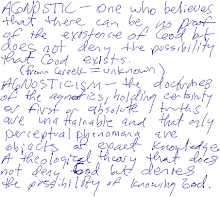
As an absolute agnostic, I'm quite fascinated by the Universalist Unitarian's lack of a single perspective, or said another way, their openness and integration of the diverse viewpoints of many. I was even more intrigued to find out that many UU congregations even have atheists among them.

I've long contended that an agnostic is nothing but a polite atheist, aware of both the upsetting nature of his/her beliefs on others when expressed as well as the personal liability of being a non-believer in a world of religiosity. It is encouraging to see a congregation that seems to be more focused on living together as humans than the elevation of a world view, godhead or political institution. Thanks Kat for sharing your academic paper!

Happy holidays to all and here's wishing for a 2010 with more joy, prosperity and tolerance for all.

Monday, September 21, 2009

September 21, Mist Betwixt and Between Oak-Leaves

The mist is thick on Main Street, the mist thicker on Porter where the houses are farther apart, the yards over grown between lots, several houses empty awaiting destruction, sale or tenants. Tall white oaks hundreds of years old, witness the moments drip one into the next amid scattered showers and thick fog.

Coyotes and foxes have taken to the brush on Porter as of late and tonight they scamper about, Indian Summer announced, but the nights have not the will to stay warm. And tonight my bones ache with the damp, the mist softens my vision and discourages visitors to this part of town.

It's wonderful. I listen to the haunts of Dead Can Dance, expecting an owl to sound or a hand to reach out of the past from beyond the veil and grab my flesh, to spook me back into believing that it is not simply this and then nothingness.

Whether 60 years, 60 days or 60 hours more, these last few weeks have been joy. Angst and fear largely at bay. Time with children, moments with nature, moments with myself, moments... life is a series of moments dripping by, bleeding one into the next, but so subtle, so steady that the bloodletting goes largely unnoticed until some event. Some event that "pulls the rug out from under us" as Chogyam Trungpa said - a funeral, a wedding, disturbing news completely unexpected. Some event that makes linear time seem silly, suspending the part of our mind that looks for walnuts and acorns to bury in the yard, should winter be long and hard. Whether 60 years or 60 days more, what joy without fear. May I keep fear at bay.

Indian Summer will surrender, autumn in turn, winter will be wonderful even if long and hard. Each season in its time, the cliches I write about, none of them fully memorable until that sight, that sound that smell of soil in air whether spring rotting leaves about to give birth, autumn crisp air, cool, but smoke filled, or cold, cold, biting breath of the after Christmas, none of these things are real until and only during the moment a season fully unfurls.


though we are not yet in the moment Ms. Millay describes below, I know it won't be long and I feel the leaves she speaks of cling (perhaps float) betwixt/between one season and the next, one moment and the last... thank you Ms. Millay.

The Oak-Leaves by Edna St. Vincent Millay from Wine From These Grapes (1934)

Yet in the end, defeated too, worn out and ready to fall,

Hangs from the drowsy tree with cramped and desperate stem

above the ditch the last leaf of all.

There is something to be learned, I guess, from looking at the

dead leaves under the living tree/

Something to be set to a lusty tune and learned and sung, it

well might be;

Something to be learned – though I was ever a ten-o’clock

scholar at this school-

Event perhaps by me.

But my heart goes out to the oak-leaves that are the last to sigh

“Enough,” and lose their hold;

They have boasted to the nudging frost and to the two-and-

thirty winds that they would never die,

Never even grown old.

(These are those russet leaves that cling

All winter, event into spring,

To the dormant bough, in the wood knee-deep in snow the

only coloured thing.)


Monday, August 24, 2009

All Summer in One Night

All summer slips past me in one night,

the night where warm turns cool, where fireflies vanish

and autumn begins, even if sunny August & September days seem summer again,

autumn has begun and winter’s always within;

but before this night where summer slips, there was all of summer in one night,

or thirty six hours.

August half over, panic that an unseasonably cool summer would go straight to winter,

the sense that life passes equally fast and two years have gone by largely unconscious,

I planned all things summer for one day/night (and other things summer just happened) –

unplanned swim with childhood friend, our sons meeting for the 1st time, parallel play

not just for children, so conversation was disjointed, but still delightful,

paddle boats in the quarry with cousins, uncles and aunts, fish floating beneath the murky water like they’ve always floated in my dreams and in the lake of my youth, Leawood , Kansas, a long walk along the river, dinner and setting up camp for a sleep out, but first ghost in the graveyard, my sons first game of midnight rider, pure joy, one o’clock, two o’clock, three o’clock, four, five o’clock, six o’clock, seven o’clock, eight o’clock, nine o’clock, ten o’clock, eleven o’clock, twelve o’clock, ghost in the graveyard, ready or not here we come…

only my oldest brother and I actually slept outside in tents, the ground was hard, the crickets loud, the night not yet cool… the best I’ve slept in quite some time…

breakfast with me at the skillet, spinach & onion, lots of coffee and fruit, a short car ride to the zoo, an August thunderstorm while we took lunch under cover, bears, elephants, kangaroos, a carousel ride too many and we barely make the tunnel before the 2nd thunderstorm begins… I run to the car laughing, more like swim, the rain is warm, thick, the day, the summer, all of it within thirty six hours, thick, delicious, the recipe perfect, family, friends, sunshine, shade, laughter, exercise, rest, libation, presence, respite amid August before winter coaxes the season into autumn, the nights into coolness, the fireflies into slumber or where ever they go that final night when summer ends


Montauk reference by poolside at start of all summer in one weekend, reminds me of the following:


November 3, 2004 6:15 a.m.

Meet Me in Montauk (RE: Eternal Sunshine of A Spotless Mind)

lucid day dreams or dejavu

memories of you fading,

evaporating, dissipating

and no one can save them…

“blessed are the forgetful for they get the better even of their blunders”

but blunders haunt beyond the specific

smell and look of a gray winter day

forever locked in pain, the sadness

lingers the ache meanders

through grey matter even when the “blessing”

of forgetfulness erases the exact root of the ache

and thus the forgetful end up cursed

not able to search the wounded waters

of regret and hurt to find the part of themselves

that was once whole, spotless? spotted?

nearly extinct elephants in New York before Madison Square Garden

the circus absurd in the city, the city a circus absurd on a snowy beach Long Island

on a gray winter day slipping into darker gray, light snow blowing

sand sleeping below, sand “over rated just being really small rocks”

flashlight photography glimpses of the events that led to this

captured on degradable film, that led to this latest

attempt at escape

only to discover what we discover last, time and time again

that the way out is the way back in

only to discover what we discovered last time, time and time again

hidden from the mind is a familiar secret

not rememberable until dead;

that when given the choice

we chose to do it all over again

we chose against the eternal sunshine

of a spotless mind

Beck’s voice haunts the surf hazy night

back in gray winter, the snowy beach of my memory

as I search for my father’s hand outstretched

from whence I came and from where

I shall return only to pause,

reflect, reform and return

to struggle to ache to yearn

too often missing the moment;

forever to be enjoyed

Tuesday, February 10, 2009

One Night in Bangkok, Every Night (Yeti Friend)

Forgive me father, it has been six months since my last blog.

The snow falls in Denver, sixty degrees in Chicago,
after more than a month of well below 30, well below 20,
often below 10, days below zero, but today, I'm in CO
and it is momentarily colder than Chicago.

The economy is collapsing, at least shrinking,
my belly growing, or at least holding steady,
bigger than I like, my children are growing too fast,
for me, too slow for them, maybe, maybe just right for both of us.

I miss them tonight, I'm not chasing immortality, I'm not chasing fame, I'm trying to pay for their education, food, clothes and to secure their happiness, trying to align or find my own happiness with the work I do, cuz I do a lot of work, more time than I spend with them, it's a classic catch 22, I work to support, I support because I love and I brought them into this mess or dance (depending on the day - my day), and I spend less time with them.

This is not new, this is age old, but my subtle sinking into this position is strangely ok. I'm not disappointed in myself, I'm not overly proud, I'm not disgusted like I used to be with people like me. I do want more joy.

More joy when home, more joy when at work. No matter what, if anything happens next, my time as this person, as this father and husband is limited and love is no less real than god, no less real than my back pain, no less real than more trivial things I concern myself with, yet it is not either or, it is not either cave of meditation with yeti, yak, snow lions my hermitage friends, or
one night in Bangkok every night drowning out the silence and loneliness with prostitute, temporary friends, noodles and beer (though I swear I've never been).

It's not natty beard, ashram, vegan sex or Wall Street, drycleaned, steam pressed ROI on a soul capriciously spent.

It is not either this or that, it is always both, it is always the betwixt the between the interbeing. My life moves back and forth trying to find balance between suits and ties and tattoos, gods, animism, cynicism, after life, belief, disbelief and rest.

My heart beats irregularly, I'm happy to be alive, a privilege to contemplate even if inane.

Peace, good night, Conan