Tuesday, April 4, 2023

 The Little Bear                      from The Lighter, Valparaiso University

I sit on the slanted rooftop, the grain digging into my shorts
A little bear with the round ears plays violin in a beautiful melody on the sidewalk below,
All by himself.
His fur is perfectly trimmed,
If you look closely you can see the brush strokes that made him.
He stands on two padded feet,
Down on the sidewalk.
He can’t be more than five feet tall.
I watch him from my rooftop in my quiet suburban neighborhood.
The sun sets at my back; I feel the heat emanating from its distant power.
The little bear holds the violin so proudly on his forearm;
He bears it as a gift to the world, like a mother proudly showing off their newborn.
There is a fine line between beautiful, floating melody and the screeching sound the violin makes when you play it just a little bit wrong.
How does the little bear balance it so well? What I think sounds like a screech at first turns into a high, piercing note that floods my eardrums and slows my heartbeat.
I get one last look at the sun’s blanket of orange-gold light, striking birch trees in the neighbor’s yards reflecting their perfect green leaves back at me.
All I want is to play like that little bear
I lift the thin-bladed saw from the shale-colored rooftop and hold it in my right hand,
It is perfectly weighted with wood on top, resembling a straightened coat hanger.
It’s so light it makes me giddy.
I raise my left forearm to the cerulean sky where the sunlight hits it just right.
I lift the saw in the fingertips of my right hand, a salute to the little bear.
Then I begin to play.
I play a melody no one has ever heard before,
Letting the saw slide across my too-pale forearm,
Intersecting blue veins.
Crimson blood spills out of my arm as the melody plays to the tune of the little bear’s,
We’re in perfect harmony.
The strings in unison make me lightheaded; the sky gets lighter and lighter; my knees grow weak on the slick rooftop.
I don’t know why but it only hits me as I bleed out on the rooftop—
My life was for nothing.
I pandered and pleased and existed long enough for me to hate myself,
Long enough to be sick to my stomach all the time.
My veins look so pretty in open air,
Their brilliant electric blue contradicting the vibrant red they bathe in.

I begin to laugh softly to myself, a grin on my colorless face
I’m losing blood fast.
I couldn’t believe my luck—
For in the moment that I played my tune with the little bear,
I knew there was a god, watching from that cornflower blue sky, smiling on me as I played my tune
Telling me
That I was special.
I lean over the slanted edge of the rooftop, barely keeping my balance as I sit, wobbling.
The little bear stops.
His warm black eyes stare up at me from the street like little dots of coal
His violin rests at his side, bow in his right hand.
He doesn’t move
And then he raises his bow and instrument
And begins to play the most beautiful song I’ve ever heard in my life.
It resounds through the street, a crystalline melody so free that no microphone could capture it
It serenades me as I drift off, the cloudless sky slowly fading from my eyes.
The melody is gorgeous, and I finally smile.
My head settles against the slate rooftop, and I shut my eyes. 


Ronan Nadim Cassidy

Saturday, June 11, 2022

The work world and the soul (your soul)


 The work world and the soul (your soul)

To my children and anyone who will listen. I see you now, flirting with the adult world, considering what to do to put food on the table and perhaps some grog. Fret not, at least not too much. Fear never leads to anything good except not getting hit by a bus and even that is more instinct and adrenalin vs. fear which will have you freeze in your tracks and become flat.

I remember stressing so much about what I would do "with my life".  What I would do to make money. I wanted to be great at something. I didn't care about money per say, but in my mind there was either selling out to make money or being a homeless poet, there was nothing in between. Fortunately, my entire life has been something in between.

When people would ask what are you going to do, I'd get really uncomfortable as I had no idea. I was studying English so the natural thing was to become a teacher, hey and you get the summers off. Everyone said I'd be great at it. But the further I got in the program the less I felt good about it. I did observations in grade schools and high schools and while I liked the students, I didn't see teachers that I wanted to emulate. I didn't know how to teach and my teaching program wasn't teaching us how to teach. I thought I had to know everything to teach and I felt like I knew next to nothing. I realize now that it's not about knowing, it's about leading and facilitating and we all know more than we think. It's about confidence or faking it till you make it. I expected that I had to be the Michael Jordan of teaching and I panicked and quit right before my student teaching. I took what was there waiting for me, management at Walgreens.

The corporate story of health benefits and a 401k and maybe making $100,000 per year as a store manager welcomed me. The truth was that retail is brutal, especially in Fresno, CA. I was hit, yelled at, threatened daily, escaping from Samoan drug dealers only after the store's security guard called his Hmong gang friends to escort me home. I was making $10 or $11 per hour, less as I was "management" and exempt from an hourly wage. The $100,000 which I hoped would buy me some respite from life, some insulation from suffering was a long way off. Even further away was retirement and that 401k which I thought would bring me some security. And fortunately, at 23, I didn't yet have much use for health insurance. But I did get a snazzy blue smock.

So now I see my kids and step kids graduating high school and college and already working. My advice, be happy. Yes, you have to make money to eat and thrive and the other side of the equation is limiting your obligations. If you can maintain good health, stay single and avoid having kids, you need a lot less. Now, I want some grandkids and I can wait. And I think you can find work you love or at least like most of the time and make money. I'm doing it, but my 23 year-old self couldn't imagine it. It was either or, either poor poet barista or soulless wolf of wall street. Turns out, there's plenty in between.

Stay curious, keep learning, follow your heart. Explore options and pathways while your obligations are minimal. Work hard in whatever you do, it matters, people notice and opportunity abounds when you pay attention and expel effort. I couldn't see the path my work life has taken at 18 or 23, really not even at 30, in fact it was still evolving at 40, even 52. And now I talk about retirement, but I know there will still be a few more stops along the way and I'll have more and more say about what those stops are. I'm becoming less willing to put up with shit and I've put myself in a place to afford myself this attitude.

Whatever you are doing, even if you know you won't be there long, say to yourself I choose this. Do your best, learn what you can. Don't be afraid to leave a shitty job or situation and don't run at the first discomfort. Keep looking for clarity as to "what you want to do" and for me it didn't start to clarify until about 40. Even then I felt like I was making it up, faking it. We all are. Have fun, believe in yourself. 

If you find yourself dreading a job, you probably won't be there long. Don't quit a job till you have a job, unless it's unsafe or toxic. Follow your heart, pay attention, do your part and your work life and your soul will align. Of course on some deeper level, both are illusions and we don't get long with either.

~ Conan Malone (pops)

Friday, January 30, 2015

Remembering Ilias and Frank


Remembering Ilias and Frank

Thirteen years ago today, in just a couple hours, my father slipped away, peacefully at home.  The sun was shining on a clear, crisp winter afternoon, snow on the ground, the blue jays screamed, harolding his passing, mother was on the phone with Aunt Mary Jane, Tim and I were out coffin shopping (aside on this to follow), Chaunce was at work.  My father hadn’t been alone without his wife or one of his kids by his side for over a month.  I was in from Colorado and I slept on the floor next to his hospital bed.  We took shifts, we made 3,000 calorie Ensure shakes that he would sip and the brothers would drink… Dad chose this moment, in control up the last, to go; to go quietly without pomp or circumstance, his last exhale left his body in front of his caregiver.  Dad wasn’t much for showing weakness and he didn’t like being sick, he wasn’t going to die in front of his wife and kids, so he chose this quiet moment and he left.

A couple weeks ago we celebrated the life of Dr. Ilias Karas.  The passing of another pillar of positive patriarchy surfaced all of the feelings I had when my Dad was dying; the moment I found out he was dead.  Tim and I had stopped for a quick bite to eat at Joe Daniels, Mom called, “he’s gone”.  We stood up, left our order and sped home.  We were home within ten minutes of his passing, but it felt like he had been gone longer, the world felt different, like Nick Karas said, part of me was ripped out and taken from here to beyond. There was an emptiness that I felt inside me, I saw his body, still warm, but Dad was clearly not there.

I felt so privileged to be a part of the weekend of remembrance with the Karas/Dennehy Clan, eating, laughing, drinking, singing… his children eulogized him each in their brilliant authentic way, his children and grandchildren, wife, family and friends the true testament to an incredible man, the legacy of Dr. Ilias Karas lives on.  I was one of the neighborhood kids who saw Dr. Karas, not for tonsils, but for sinus surgery.  Dr. K. once saved the life of a colleague of my father who had throat cancer.  Slight in stature, big in skill, intelligence, welcome and persona.

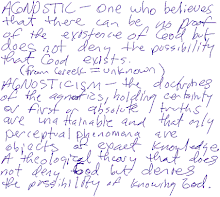
A long-time family friend, Dr. MacEntee, eulogized him as well; the two men could not be more different in some ways, one from Greece, the other from Ireland, one “agnostic” the other Irish Catholic, but both committed to healing and serving others. Dr. MacEntee said Ilias could keep a joke going for years.  Dr. MacEntee was with Dr. K in the final hours and he reasoned with him to essentially hedge his bets, “what if you’re wrong Ilie”, few could communicate with Dr. Karas at this point as communication was very difficult, but still Ilias responded, “It would be dishonest.” 

In addition to being one of the legendary father figures and professional figures during my youth, later in my life Dr. Karas became my hero from a far for having the courage to question, to openly admit agnosticism in a society that boasts separation of church and state, but for all practical purposes, demands conformity in faith and many other things.  Both men died in the bleak midwinter, Ilias died at 79, Dad at 80. Rest in peace Ilias, rest in peace Frank.  Different men, strong men, fathers who left a legacy no matter what does or does not come next. 


To read about my father go to 2010 at right.  Tuesday, January 26, 2010, Remembering Frank E. Cassidy.


http://chicago.suntimes.com/news/7/71/292171/dr-ilias-karas-survived-wwii-deprivation-greece-find-success-america

Dr. Ilias Karas, who survived WWII deprivation in Greece to find success in U.S., dies at 79

Posted: 01/15/2015, 05:31pm | Maureen O'Donnell

Dr. Ilias Karas liked simple food and complex debates.

He loved an unadorned Mediterranean feast, dipping bread in homemade yogurt and snacking on figs and oil-cured olives. He enjoyed spirited discussions of politics and history, something friends and relatives attribute to his having grown up in Athens, which gave the world democracy and the philosopher Socrates, who used questions to get to the big answers.

Dr. Karas, 79, died Dec. 9 of kidney disease at his retirement home in Naples, Florida.

Outgoing, irreverent and funny, he was the kind of man who’d roast a lamb on a spit and invite the entire neighborhood over to enjoy it.

Though he visited Ireland every year with Marie, his County Kerry-born wife of 49 years, he found fecund joke fodder in Ireland’s rainy weather and spotty central heating. Once, when his Irish brother-in-law urged him to come in the house, Dr. Karas replied, “No, I’m warmer standing outside than I am inside.”

He loved spending time at his condo in Acapulco, staring at the waves and luxuriating in the warmth, which reminded him of Greece.

Dr. Karas liked studying the markets and monitoring his investments. He read the Wall Street Journal from cover to cover, and he wouldn’t make plans on Friday nights when “Wall Street Week” was on TV. He bought farmland in Lemont and later sold it for development. The chair of otolaryngology at Advocate Christ Medical Center, he was the picture of a successful physician.

But Dr. Karas never forgot the deprivation he experienced as a Greek child in World War II.

“I’d say, ‘Dad, c’mon, enjoy yourself, why are you so frugal?’ ’’ recalled his son, Nick Karas. “He said, ‘I feel like at any moment, it could possibly be taken away.’ ”

He survived the Axis occupation of Greece, when German, Italian and Bulgarian forces carved up the country and starvation ruled in his hometown of Athens. An estimated 300,000 Greeks died.

“He saw people starve to death on the streets that didn’t have family,” his son said. “They literally were provided with no food, and you banded together with family and close friends, and if you didn’t have that, you literally starved to death.”

What may have helped the Karas family survive was that his butcher father had contacts in the meat business. But their diet consisted almost exclusively of bread, yogurt and water, his son said. On a good day, they had olives.

What little food there was went first to the Germans rolling by in tanks, or quislings who cared more for full bellies and political advancement than national pride.

The young Ilias Karas also spent two and a half years in the hospital after contracting polio, which left him with a limp. But he continued his studies and was double-promoted. He went on to medical school, and once he emerged from the University of Athens, his parents “thought the best would be for him to go to the United States,” his son said.

In 1963, he came to Chicago because of ties to Greek churches here, his son said. He shortened his surname, from Karagiannopoulos to Karas. He used to say, “People talked about how they immigrated to this country with $1, $5, $10 to their name — I came here with negative $300 because I owed a friend in Athens for my airplane ticket over.”

As a young resident at Edgewater Hospital, Dr. Karas’ resources were so limited he didn’t have the money to return to Greece for his father’s funeral when he was hit by a car in Athens that same year.

Though he came to America on a medical student visa, a brief window — perhaps a month long — allowed medical students like him to apply to stay on, his son said. Dr. Karas filled out the papers. A friend, who missed the deadline, had to return to Greece. “My dad always told me, take advantage of everything you can, because it might not be here tomorrow,” his son said. “He thought it was the best country in the world.”

He and a nurse, Marie Dennehy, fell in love. They married and took off a month each summer to bring their four children to visit relatives in Ireland and Greece. Mr. Karas was the only one of his five siblings to immigrate. His wife had five brothers and sisters in Ireland. The trips were glorious for their children, who played with an estimated 60 Greek and Irish first cousins.

Eventually, he became head of ear, nose and throat medicine at Advocate Christ Medical Center. “He was wonderful with patients, tremendously popular; very gentle,” said a friend, Dr. Peter MacEntee. As teens, his children became used to hearing from friends, “Your dad took my tonsils out.”

The Karases raised their family in Palos Heights and Palos Park. He taught his wife how to make yogurt and how to season fish the Greek way, with lemon and oregano. He told his children how the Greek hero and military genius Alexander the Great conquered much of the known world by age 25.

Often, Dr. Karas worked till 9 p.m. He and his wife recharged by taking their family to Acapulco for Christmas each year. He also enjoyed trips to Africa, Australia, India, and going on cruises.

In addition to his wife and son, Dr. Karas is survived by his daughters, Katherine Karas Murphy, Marilynn Karas Borock and Jennifer Karas Maconochie; sisters, Ritsa Anagnostou and Stella Karagiannopoulos; a brother, Marios, and 13 grandchildren. A mnimosino, a Greek memorial service 40 days after death, is planned. A wake will be held from 5 p.m. to 9 p.m. Saturday at Hills Funeral Home, 10201 S. Roberts Rd., Palos Hills. A memorial luncheon is scheduled at noon Sunday at Palos Country Club in Orland Park. His family plans to spread his ashes in Acapulco.

Thursday, September 4, 2014


Dear Barry,

I’ve been putting this off ever since I got the news that you were gone. 

I remember your office in the back of the Continuing Education suite at Paramita.  No windows, none needed, work was done in there and you came out from time to time, as needed.  I remember you pushing dirt and gravel with your feet behind the building, behind the Cork, smoking, laughing like you did, sudden, breathy, I can’t quite imitate it.

I remember you installing the ceiling fan in our first townhouse, I asked, “will it hold?” you said “oh yeah, sure, I think” and then laughed like you did.  It held.

I remember you going in for open heart surgery, you gave us each a wooden heart with our names on it- I put mine behind the walls, in the foundation of that townhouse to make sure you were a part of my foundation, your are.

I jump ahead to the present, I’m at a large college and still there is no good solution for an ERP/CRM for Continuing Education save for what you created in 1998 in Lotus Approach.  You kept supporting your software solution (creation) after you moved away, after you moved back and after IT ordered you not support it as it was way outside of your normal duties.  You kept supporting the system as you knew without your system NUCE could not serve its students.  You slept on the couch at Sangha House to save us money, you worked for free when we couldn’t pay you, you smoked cigarettes in the parking lot, you laughed, you made others laugh, you gave of yourself again and again.
Years pass, miles divide us and here I am writing a thank you, an apology after you are gone.  I wish I could have done something to ease your pain.  You showed up time and time again for all of us… I hope you took with you some sense of the joy and love you spread.  I want to go back to our Longmont townhouse and tear open the walls to find the cracked wooden heart that bears our names.  Maybe if I held that small token my heart would not ache like it does.

I miss you Barry.  I love you.  You were a mentor to me, a big brother and a friend. 

Tuesday, December 31, 2013

Into the Wild mundane

Some years ago while searching through the magical amid the mundane in Boulder, CO at a university of seekers, a colleague loaned me the book Into the Wild.  The book by Jon Krakauer is a tale of a young man named Christopher McCandless who graduates Emory University with honors and donates his life savings to Oxfam, shunning his life of privilege to experience life in the wild.  McCandless cuts his credit cards, cuts contact with his family, discards almost all of his possessions and drives his Datsun west in search of himself.

With the seeker in me all but resigned to finding small micro moments of magic within the mundane, I came across the 2007 movie version of Into the Wild in Netflix last night.  Romantic nostalgia arose within my chest and head-- memories of reading Thoreau and Emerson as a disillusioned teenager and projecting  peace onto nature arose in my mind.  I remembered hours spent in the Palos forests searching for contentment within the wood, solace within nature.  Fortunately, when I got cold and hungry I only need cross one busy street to get to my neighborhood – Ishnala - which interestingly enough means “by itself alone” in Winnebago…

This week between Christmas and New Year’s is historically the toughest time of year for me.  With a slowdown or stoppage in the normal hectic work pace that keeps my mind occupied, troubled thoughts of isolation (by itself alone) usually surface after the holidays fall short in delivering the full promise of peace, bliss and contentment advertised by Kay Jewelers, Lexus and Apple.  But this year and for the last several, I'm much more tempered in my expectations and more fulfilled by the little seemingly mundane moments of magic with family and friends (or at least less haunted by and bored with existentialism).

So, I turned on Into the Wild half curious if the protagonist’s struggle would pick at the scars of past wounds, uncovering old longings to simultaneously connect to others and checkout of a chaotic, overwhelming world or if the story would be lost on me, skin having hardened to armor, romanticism replaced by practicality.

I felt very alone in high school even when among the popular kids.  I played sports, I partied and no one would have guessed as to the battle between the wild extrovert and the hurting introvert playing out inside my head and bedroom after practice, after parties after a normal day.  Maybe it was the red hair, maybe it was transferring from a Catholic School to a public school in sophomore year, or maybe it was my traumatic genetic inheritance that serves you well when surviving the “troubles” but spins a thick web of anxiety in privileged suburbia with few real threats to survival.  Together it was a different way of thinking and seeing (not as different as I thought) that was both my pride and my pain.  Loneliness amid the popular crowd, the burnouts too, alternating activities between the jocks, Catholic school kids and some wonderfully odd social combinations therein.

All of this circuitous rambling to say in some way, I remember relating to Christopher McCandless, though I was not as brave, not as courageous and he found much quicker than I that true happiness comes not in isolation as poetic and alluring as it seems, but from sharing moments with others.  Unfortunately for McCandless, this discovery cost him his life.

McCandless, all of 23 or 24, having adventured across the United States, spending time with other seekers, ends up trapped in the wild when a river he crossed 9 weeks earlier in Denali State Park Alaska swells and becomes impassable.  He returns to the abandoned “Magic Bus”, his temporary home sad and now aware of how random and cruel nature can be. 

He is seemingly ready to return to family and friends, to rejoin society, but trapped in the wild.  McCandless was unaware that a hand tram a ¼ mile down river would have allowed him to cross the swollen, violent river and walk out.  Instead, he returned to the magic bus that was now anything but magic and he attempted to resume living off the land, but he was increasingly weak and starving.  Toxicologists and naturalists debate whether he accidentally poisoned himself through ingesting a wild pea plant relative, a mold that can grow on it or if he just fell victim to “rabbit starvation” where increasing activity outpaces a lean diet unable to sustain someone in the wild.  Tragically ironic, McCandless’ Oxfam donation to end the hunger of others at the start of his journey foreshadows his own demise in the wild.

Many were angered by what they saw as his arrogance to think he could walk into the wild, ill prepared, ill equipped and survive.  I tend to side more with Sean Penn who directed the film and author John Krakauer who present a seeker driven to seek isolation by his inability to make peace with the worst of what he saw in humanity.  McCandless’ personal and spiritual ghosts led him afield, yet his apparent wisdom led to a massive personal transition across a two year journey and some three months in the wild.  Unfortunately, his epiphany came too late for his physical body to make it back to the world of people.  I’m not angered by his survival inexperience. I think he did pretty good. I don’t need to label him arrogant to distance myself from the discomfort of the wasting of a young life having some personal experience with the haunting within from the short comings of the human condition.  I’m just happy to have lived beyond the romantic reach of existentialism which in me makes good poems, but contributes to piss poor living.

If you haven’t seen the film or read the book – I suppose I’ve spoiled the ending, but you may still want to check it out if you have any part of you that struggles with feeling by itself alone amid the herd, lonely and at home amid the flock, or just curious as to the interplay between the magic and the mundane in the micro-momentary paradox of longing for connection while desiring some comfort in solitude.

Wednesday, October 23, 2013

Take me back to Missouri


Was leaning against Tom Johnson’s house humming what would become my first and only blues song, take me back, back to Missouri, la da, la da, la da, la da da da, la da, la da, la da, la da da da… got tired of waiting for Tom, no telling where he was at, Mr. Submarine or suburban party, but somehow I was at Tom’s no car, miles from home.  Kept humming, take me back, back to Missouri, la da, la da, la da, la da da da, la da, la da, la da, la da da da, started walking Tom’s yard, headed toward the small cemetery, heard some other voices, laughter, voices, take me back, back to Missouri, la da, la da, la da, la da da da, la da, la da, la da, la da da da, I seldom pass a cemetery, but I went toward the voices, under the bridge along the train tracks, I saw dark figures huddled around a fire in the middle of the tunnel… I approached steadily, take me back, back to Missouri, la da, la da, la da, la da da da, la da, la da, la da, la da da da, when right up close, the group turned, startled, without missing a beat I signaled hello to two girls from class who worked on a paper with me or I with them, psychology, Satanism as religion, I had never seen them out before, never been under this bridge before, I walked right up, take me back, back to Missouri, la da, la da, la da, la da da da, la da, la da, la da, la da da da, I think one was named Leddi, the other… both goth, their friends sniffing glue by the fire, I said nothing, walked up to Leddi embraced and made out, take me back, back to Missouri, la da, la da, la da, la da da da, la da, la da, la da, la da da da, if I had any balls, any courage, I would have dated Leddi all of high school, married her and had goth babies, take me back, back to Missouri, la da, la da, la da, la da da da, la da, la da, la da, la da da da…

Friday, January 4, 2013


Aunt Mary was the matriarch to our family for so many years - Grandma Gannon having died so long ago. She took interest in the lives of her 22 nieces and nephews, provided council, remembered birthdays, witnessed our lives, births, birthdays, communions, confirmations, weddings, every major event, many minor events, witnessed by the our aunt. Aunt Mary worked from 13 to 55, taking on responsibility for her 8 brothers and sisters with her own father dying when she was a young woman. I feel empty inside knowing our matriarch, our witness has moved on. Wishing you peace aunt Mar. Love, Joe

For anyone unable to attend the wake, feel free to take a look at this slide show of photos that capture a small slice of our Matriarch's life. Many of those Aunt Mary loved are missing from the slide show given the short notice and limited access to photo albums.         http://youtu.be/kkcC5gLscgg

Saturday, December 8, 2012

FILLIN' THE HOLES I DUG (A BICYCLE BUILT FOR TWO)


(from the Pollywog Papers 1998)

I dug holes for seven bucks an hour.  Now I fill them for seven seventy-five with obsolete mothers and fathers.  I dug ditches to take human waste away from ugly houses that cost a million dollars.

I dug holes, now I walk wasting humans to the holes, I walk them down pleasantly painted halls where the smell of urine and feces often rises.  I lead them toward the holes I dug and gently push them in once they are too tired to roam the halls of this world searching for some moment, any moment from their youth that eludes them now.

Some families react very well, they come and walk with us, they walk their parents with dignity and love into the holes I’ve dug. 

But most saw this place, these hallways, the tiny apartments within as a welcome hole in which to dump the waste of their parents.  They pushed their parents in the hole of this place and sped the car away from the discomfort of seeing their parents so wrinkled and confused.  They shut their ears to the precious life stories of growing up in one bedroom apartments in New York city with seven brothers and sisters.  They let a stranger hear of the days without any money, with little  food over decaf coffee and ginger snaps, singing:

“Daisy, Daisy Give me your answer do, I’m half crazy all on account of you…”

Walking down the hall hand in hand with a young stranger with short red hair and an awkward smile, toward the holes…

“It won’t be a stylish marriage,
I can’t afford a carriage,
but you’ll look sweet upon the seat,
of a bicycle built for two”

bum bum...

Friday, November 23, 2012

Bataan Faigao, R.I.P.

Naropa University has a history of attracting seekers and teachers.  I was saddened to hear of the loss of Bataan Faigao, one of its favorite teachers who kept seeking right up to his death.


I remember Bataan doing a demo of Tai Chi in Shambhala Hall in the historic main building.  A really big, cynical guy challenged Bataan after he talked about being as hard as steel or being extremely loose, depending on what the circumstance called for.  He invited the big guy forward and he towered over Bataan.  Bataan invited the big guy to try and push him over - the big guy tried with all his strength, but he couldn't budge Bataan, he was immovable like a mountain.  Bataan paused and asked the big guy to try again, this time Bataan stayed hysterically loose and flexed and bent as the big guy nearly fell over as he pushed hard and found no resistance.  The big guy looked stunned, confused, everyone laughed awkwardly then applauded loudly... I have many pleasant memories of witnessing Bataan doing Tai Chi, even practicing with him on occasion.  I practiced Aikido w/ Bob Wing, but was always in admiration of Batann's skills and wisdom and his practice and his stance in life... sometimes standing like a mountain, sometimes bending like a willow in the breeze.  Peace to you and yours and to Bataan.
Conan Malone


from Tambi Harwood, daughter of Bataan and Jane Faigao

I am finally posting what I read at Dad's memorial.

Both of my parents died the way they lived their lives. My mother went out in a blaze of glory. My father slipped away quietly. My mother was here and her death was tangible, witnessed and felt by a multitude of people, visitors who came to see her until she was too tired, her mind too far gone. My father died in a place of imagination and poetry. We can only imagine what it was like where he died, how he died. We make it up in our minds, like we have to do when we read poetry. We see images in our minds. Wu Dang Mountain, birthplace of T’ai Chi, happy when they brought him dinner the night before, and when they woke him up, no breath, no breath. We make up stories in our minds about how he died exactly where he wanted, when he wanted and how he wanted. And for us, it is true. And it is an illusion. They both died dramatically. My mom died a loud, dramatic death, yelling at Bataan for poisoning her, hitting, slapping, kicking, spilling water. And then she was burned at the stake, she always imagined herself joining her sisters being burned at the stake. My father died a quiet, equally powerful death. Powerful in its silence. Dramatic in its setting.

I want to tell you a story about my father’s death. The night after he died, I got a call from his tour guide. He explained in English with a strong Chinese accent how hard it was to bring my father down from the mountain, how much work it was, how much money it cost for all of the laborers. He explained in broken English that it would be very difficult to get his ashes and his belongings back to the United States. But he could do it for $15,000. He needed it right away. Just wire the money to New York, and his friend in New York would wire it to him in China. It was partially my fault, because when I found out that Dad had passed on in the hotel and told him to do whatever it would take, no matter what the cost, to take care of him. I took it back, that night. I said, I don’t have $15,000. What about $10,000 he said. Just wire of $10,000, but I need it immediately. Wire it to New York, and my friend in New York will wire it to me. My husband said, he’s trying to run the Nigeria scam with your dad’s body.

I did not send any money to this man who dressed my father in t’ai chi clothes, with socks, and t’ai chi shoes, at considerable cost to himself, and put a jade turtle in his mouth. None of this do I see with my eyes, it all happens in my head, in the landscape of my mind. It is poetry. My father is not just a poet, he is poetry.

The misty mountains in Wu Dang, birthplace of T’ai Chi, poetry. When I asked my father what he wanted to have done with his body after he died, because we talked a lot about life and death when he found out he had liver cancer this summer. When I asked him what he wanted, he said, just burn my body, and bury me in a cardboard box. He always talked about living in a cardboard box. That is exactly how we will receive his body from China, in a cardboard box. My father was not just a poet. He is poetry.

I thought this thing about the money was hilarious. I think my father would have found it funny himself. When he went to the Philippines 12 years ago, he told me a story about how he got lost and ended up in a whore house. They kept sending girls to his room. No, no, he said. I don’t want a girl. So they said, a 12 year old? No, no, he said. A man? No. He locked his door. But it was a good story. Like this, this is a good story. The story of my father on a pilgramage to the Wu Dang Mountain, the birthplace of t’ai chi, dying where he wanted, when he wanted, how he wanted. Not being a burden to his daughters who had already lost a mother. Because, after all, he wouldn’t be there to take care of it. And the story of the tour guide trying to run a Nigeria scam on his daughters with my Father’s body. My father was not just a poet, he was poetry.

Sunday, April 8, 2012

When a Giant Falls pt. 1... in memory of Mike Sterchele

When a Giant Falls…
Anytime someone dies, a part of you dies with that person.  Thankfully a part of them lives on in you, in your memories, in the fabric of who you are, the closer they were to you the deeper the interweaving of their lives and yours.  I think this is why it hurts so much when those who have touched you, shaped you, always been there for you die, the tear in the stitching, the rip in the fabric goes right up your spine detouring along your ribs and ending in your heart.  The whole process seems to bypass your brain, other than then the memories that come to the forefront some of which may be ten, twenty, thirty or more years old.

This is how it was for me when I got the news that Mike was dead.  It hit me in the gut, in the chest, but my head really couldn’t even begin to process the reality of the situation.  I was at work and both of my brothers called within the space of half an hour.  Though the Cassidy’s were a small St. Al’s family, it seems there was a brother or sister who was in one of our classes, or in between grades – any big news to anyone in any of the families tugged at the hem of our shared upbringing and our shared mortality.  This was the case with the Stercheles and us.  Chaunce was close in grade to Steve, Tim and Tony were in the same class, Mike was in the class ahead of me and Jackie was in my class.  The shocking passing of big, strong Mike was an instant rip, tear across the St. Al’s family fabric, and all words fall short, far short, “the spoken word is a jacket too tight... –the only thing that speaks the truth is the eloquence of passing time…”
I sat at my desk, paralyzed unable to work.  I thought the news must be wrong, but the network of friends and family was reaching out and word was spreading fast and it was real, Mike Sterchele was dead.  I’d witnessed the death and dying of my father first hand, arriving just minutes after his last breath, sleeping the last couple of weeks on the family room floor in vigil should he need anything – seemingly countless relatives had passed, even a few young friends dying before their time like Mike, but this was Mike, Meesh, Moose, Sterch, though not Irish, my honorary Big Fellah. 

I remember piling into the Sterchele station wagon heading out on an adventure, to the Warren Dunes, to my first concert – Bruce Springsteen 1986 Soldier’s Field - or just going to a party or a friend’s house in Palos or nearby – every time out was an adventure with Mike.
He pushed my edges, he took me beyond my comfort zone, he laughed with me, maybe even sometimes at me, but he always pulled back just in time so I knew he always had my back. 

The tough guys rallied around Mike, but so too did the sensitive guys, they all did.  Mike attracted action, sometimes trouble, almost always fun.  I remember one summer we let ourselves into a recently abandoned school on 127th Avenue in Palos that has since been replaced by townhomes.  It took some doing to get in, but we got in.  Mike was the one who found the chink in the armor and he was also the one who boosted one of the slighter guys up to scurry in through a boarded up window near the roof.  He then helped us force open a door.  From there, for several weeks we enjoyed a secret gathering place, complete with air conditioning and lights once we turned the power back on.  There was a small atrium outside the bathroom window.  It was completely walled in by brick in the middle of the building and a weed tree had sprouted up through the opening. 
Mike went out the bathroom window into the secret space and climbed up the tree, then used the wall where there was a foothold, back to the tree, back and forth, laboring until he got his stomach over the roof and disappeared from sight.  Mike had a natural instinct to explore and to seek the higher ground.  “Cass, come on up.”  It was difficult to refuse Mike even though I wasn’t quite sure I could make it, I started up the tree, used the same footholds and handholds until I was very close to the roof… but my arms weren’t long enough to reach the lip of the roof.  I was stuck.  I considered my options, a possible path back down, but Mike read my mind, “come on, you can do it.”  He lowered his hand – I could only make it if I grabbed his hand and let loose my foot and handholds and trusted him.  I knew he was strong, but I hesitated, he seemed certain, but I doubted. 

“Cass… grab my hand.”  I did.  I let out some sound, looked desperate, something, and Mike started laughing.  While laughing he couldn’t pull me up, I was dangling a couple stories up, my life in Mike’s hands, at least my ankles and unbroken bones, Mike couldn’t stop laughing and he couldn’t pull me up, but he didn’t let go.  I swore at Mike and he laughed even harder, he didn’t mean to, but it was truly funny, he couldn’t stop laughing, I couldn’t stop swearing, so I swung from side to side and Mike tried several times to pull me up, but he had no air as he was laughing and he did his best to hang on.  He did. 
He hung on, dropping me wasn’t an option.  Letting me sweat a little may have been, but dropping me was not possible, Mike had my hand and eventually he pulled me up.  He was still laughing, I punched him in the arm then I started laughing too.  We were only a couple stories high, but we were on top of Palos, we were on top of the world.

The night of the wake I was anxious.  I was uncomfortable in my skin.  I had a vodka or two before we left I’ll admit.  I sat in my house and cried, I balled, hard.  I hadn’t really cried since my father died, before that probably not since being a kid.  I’ve contemplated death with the Buddhists in Boulder, I’ve alter boyed many funerals, and seen death many times up close, but this was Mike.  I hadn’t seen Mike much in the past ten years, really the last fifteen, but no matter, this was Mike.  When I did see him last, it was as if nothing had changed – “Cassssssss” followed by his laugh which would shake his body and move his head down.  Next his arm would be around me – “I love this guy.”  I felt the same, no matter how many years had passed no matter what differences in philosophy we might have; this was the Big Fellah from my childhood.  It was the Mullin’s summer party and Mike was there with several characters from our childhood.  Mike ended up driving me home with Brian Bandyk and we of course went over the time Brian pushed me into his pool, late autumn on a dare.  Mike’s memory was he said wouldn’t it be funny if someone went in – and apparently I dared someone to push me in, Brian did.  When I got out of the freezing water in shock I chased Brian, but he locked himself inside his house.  I think I may have thrown some lawn furniture in the pool in frustration, Mike laughed the whole while – looking back I can’t really blame him, but he brought forth mischief like a trickster Lakota Shaman or crazy wisdom lineage Buddhist monk without trying.  I think this night I made peace with Brian… we laughed, they dropped me off and they drove off into the night – that’s how life is, you never know when it’s the last time you’ll see someone, if you did you wouldn’t let the night end.  It was late, we did our best to keep the night from ending, but it had to end and it did.  I think back now and I see Mike pull himself up and over the roof edge at that old school in Palos.  Mike disappears from sight.  The sky is empty where he was, I tell myself he is on top of Palos, on top of the world, but there’s a hole in my heart as big or bigger than the empty sky where Mike was.

Saturday, June 11, 2011

Flight from Death ~ The Quest for Immortality

I woke last night in a thunderstorm, started some work and somehow found myself on Netflix.  One movie cover caught my eye.  An alabaster sculpture of an angel collapsed on a rectangular column or alter made me recall instantly the beautiful shores and woods of Gabriola Island, BC where I first viewed the film Flight from Death ~ The Quest for Immortality.

I was attending a gathering of holistic learning centers just weeks after my youngest was born.  The trip had been planned almost a year before and I couldn't get out of it.  I found myself in the eerily beautiful Northwest, that had always struck some chord of loneliness within, intensely missing my family, feeling alone in a strange dark land surrounded by the water.

"Human beings find themselves in quite the predicament.  We have the mental capacity to ponder the infinite, seemingly capable of anything, yet housed in the heart pumping, breath gasping, decaying body, we are godly, yet creaturely..."  This film draws much from the work of Ernest Becker's Denial of Death and is a must see.  It has hauntingly beautiful cinematography, silence and space between deep thinkers pondering the human condition, being an apparent fluke of survivalism and evolution, positioning us at once for greatness and great sorrow.

There is a book or project floating out there for me that is much related to the subject matter of this documentary, Becker's work and my own search for meaning amid madness or at least happenstance...  no matter your view towards this life and an afterlife, this documentary is well worth seeing.

http://www.imdb.com/video/hulu/vi398919193/
Flight from Death ~ The Quest for Immortality

Other related film suggestions: The God Who Wasn't There and The Atheism Tapes

Future article/book from Conan Malone:  Coming Out: An Atheist in the Closet, The Story of a Catholic, Pagan, Buddhist, Agnostic, Humanist

Saturday, April 23, 2011

Becoming a Buddhist

By Guest Contributor Shiwa Oser

The most mysterious thing about becoming a Buddhist is becoming a Buddhist.

First of all, let me start by saying that Shiwa Oser isn’t my real name… or the name I go by when I’m dressed in my business outfits, hair styled neatly, in my office, typing away at my university marketing job. Not the name I use when hanging out with my family, working out at the gym, or hiking in the mountains.

Nope, Shiwa doesn’t get to come out and play all that much these days – a few miles too far from her spiritual community, or sangha. In fact, I only just met her in 2004, when I took my vows and became a Buddhist. And Shiwa was the name given to me by my new teacher… my guru.

Shiwa Oser – Peace Gold Light. She’s my alter ego, my better self, a make-believe representation of what I can become. (Or the me I haven’t fully realized or recognized.)

The strangest thing about becoming a Buddhist is becoming a Buddhist. If you had read me the above paragraphs just 9 years ago, I would have looked at you like you were crazy. Really crazy. I might have liked where you were going, I might have even played along. 

“Yeah, and I’m going around chanting ‘ommmmm’ all the time, sitting on my butt in the mountains.”

“Well, yeah, you did that.”

“And meditating for like 30 days straight.”

“Uh-huh.”

“And taking part in all sorts of mysterious rituals. Woo woo.”

“That too.”

Now that I’m away from the mountains of Vermont, the retreat center where I spent the best years of my life, and away from the weird little Buddha-town called Boulder, Colorado, it all seems like a dream… which is sort of the point I suppose. After all, isn’t that all life is? A dream that fades moment by moment? Isn’t it the goal to realize that everything is ephemeral and illusory?

In the new day-to-day conservative reality I find myself in, that’s the way it feels. Like I was riding in a shiny, multicolored bubble that has burst. But in a friendly, spontaneous sort of way, not in a ‘now what will I do?’ way. I’ve learned to be curious about my path, to accept that there really is no ground under my feet, and to try to be welcoming of the inevitable moment of my own death.

It was a whim that brought me to the Green Mountains. It was the mystery, the companionship, the sanity, and let's be honest, the fun that kept me there. I long for it, but also know I have to be a warrior in the world. Not a warrior in the protected bubble that makes me comfortable, but the bodhisattva in the fire. I am trying to bring my best to situations I find uncomfortable, tedious, and sometimes even offensive. I may still have some trouble with the world, but Shiwa is taking it all in stride.

The hardest thing about becoming a Buddhist is becoming a Buddhist. The second hardest thing is no longer being part of the religion you grew up with. From one day to the next, I had to stop thinking that God would be listening to, navigating, and ultimately solving my problems. You see, Buddhism is mostly about good old-fashioned self-reliance. No one is going to do it for you, whether “it” is being happy, finding and accepting love, or being healthy. You have to take your life in your own hands, while aspiring to be virtuous. (Emerson would be so proud.)

Changing my previous idea of God was the biggest loss for me, and in some ways one of the most profound blessings. It’s a little bit emptier in places, but my life is more genuine and I seem able to accept my quirky experiences without trying to force things to be perfect – and chastising myself if they aren’t. (Or waiting for the deus ex machina to sweep in and save me.)

The best thing about becoming a Buddhist is becoming a Buddhist. The world looks a little bit different, even if I’ve taken a short detour off my Buddhist path. It’s still there waiting for me to wake up.

I take refuge in the Buddha. I take refuge in the dharma. I take refuge in the sangha.
They are my example, my truth, and my friends. 

Saturday, October 2, 2010

Joy Flows Through me like Water

Joy flows through me like water.  Without it I would dehydrate and die within days.

On an extremely hot day, or after hours of basketball - I cannot get enough of it,  it is delicious in a bland, wet way, I cannot swallow it fast enough - but it has no taste and it has no calories.  It flows through me quickly, within minutes.  Like a compliment or praise, joy flows through me in a moment.

Conflict, criticism and doubt on the other hand, stick to my ribs like lard and fried meat, satisfyingly savory, when coupled with fatty, sweet chocolate desert, a cup of highly caffeinated, honey whole milk, Tibetan chai, bloating my being for the evening, half a week, a forte night, a decade or four.

Joy flows through me like water, the lack of Belief, a solid belief that purpose is fiction ~ Purp Fiction ~ like life, joy is fleeting, but somehow suffering constant and real amid stories of santa, satan, free market charity and the trinity.

I wish I could cross myself, absolve myself of original sin, rewire myself to absorb joy in at least equal measure with the rib sticking gristle of pain, for I'm too lucky, too blessed to be this joy thin.

Wednesday, September 22, 2010

Drowning

I'm not drowning, not now, not literally, not metaphorically.

Two weeks ago, we went to the quarry to swim and I dove in enthusiastically, waiting for that wonderful sensation of shock, of warm water still cooler than hot summer air, of the rush of the senses, of brief calm, then "SWIM!".

At first I was relatively calm, my intention being to swim across the 50 or 100 yards to the other side to my kids.  Ten or twenty strokes into it though, I panicked, fatigue set in, I was out of oxygen.  I'm not in horrible physical shape, but freestyle exhausted me and the realization set in, "oh shit, the bottom is fifteen feet, do I turn back or swim on to the other side - no way, I'll never make it, but I can swim to the floating pier half way, I think..."

I waved to my boys, played it off ligit, and gasped for air with the sixteen year olds sunning themselves on the pier.  Tok Tok Batjargal came to mind.  A man I had just met some summers ago, briefly before he drown in the summer of drownings and wild fires, Boulder, CO.  He came to an international conference on microfinance and drown in a very indistinct apartment pool only moments after jumping in. He drown in front of his colleauges, who being from Nepal were terrified of water and could not swim. The same week Kobin Chino Roshi had drown trying to save his daughter who also drown in a pond.  Tragic, none of them could swim.

I can swim, quite well I thought, but here I was contemplating drowning as muscles locked up most unexpectedly on a casual (albeit, perhaps declaratively bravado) swim.  I recalled the 1 (or 1.5 I like to say) stretch of the South Platte where my roommate and I managed to tip our canoe... I remembered to hold on to my oar, in fact I never let go even when my lungs and muscles locked up as the ice melt waters deprived me of air.  My roommate saw I was in trouble, but he was further ahead of me, the white waters moving him down river.  Somehow I got close to the rock ledge wall bordering the river, everything slowed down and I thought to myself, "you grab on and hold this rock wall or you die".  I grabbed, I held I pulled myself up, oar in hand and scrambled up the rock wall dripping wet, slowly warming up in the Idaho summer sun.  My roommate made his way out of the river some ways down.

Another time I was in a pool as a young boy with the older boys and a neighbor kid held me under the water, under a raft for a long, long time.  I always thought he did it on purpose.  I swallowed water and had to punch him to break free.

In Florida, post hurricane again as a boy, the huge surf knocked me down and pulled me out, I remember again everything slowing down, a calming, I thought "this is it", but I felt quite peaceful.  My friend's older brother was in his late teens and he caught hold of my shirt as I floated past him in the rapidly retreating water.  He barely kept his feet and we both struggled to shore.

In Hawaii it took quite some time for me to get over claustrophobia with the snorkel before I could relax and explore off shore.  Finally, I noticed the colorful fish and how they simply went with the current, swaying back and forth without much care.  I had a break through, I relaxed and I swam above eels, tangs, angels and turtles... after quite some time, say about 40 minutes, I realized I was tired.  I tried to get the attention of my friend, but he was in pursuit of a turtle.  I turned back to shore.  But shore was quite far, farther than expected.  We were in about 40 foot water and I had no flippers.  I started swimming and then I felt the current pulse out, away from shore.  I remembered hearing this might happen, and waited and then swam as it surged back in.  I did this several times, open - swim in, close - wait again, I made slow progress until my mask took on water, I tried to adjust it, but it filled up with water, I choked down some salty water and panic raced through my muscles as adrenalin.  I decided I was swimming for it, and not stopping till I hit the beach.  I was exhausted, but I couldn't look, if shore was still far off I'd surely drown.  My wife was on shore unaware of my predicament.

I swam as hard as I could, I couldn't see, I panted, I kept going until my chest dragged upon the sand and stood on my knees.  There in front of me was David Hastlehoff, yes Baywatch, huge in Germany, David Hasselhoff.  I almost drowned in front of David Hasselhoff.  He was oblivious to my struggle.

I offer all of this, not to encourage fear of water, but as I'm just back from the gym.  I swam a quarter mile without touching the bottom, without kicking off the walls as I wanted to make sure I could still swim if I had to.  I could.  I can.  But only if the water is not freezing, only if panic doesn't set in.  I told myself, the water is deep, the sky is dark, but I could see the bottom, I knew I could stand if I had to, I worked in freestyle to raise my heart rate and settled back to breast stroke, but I could't reproduce panic, I calmly went about my work, stopping at a quarter mile as it was getting late, not because I was really tired.  A quarter of mile, late at night vs. 20 yards just weeks before, what was different.  Water temperature?  Likely colder this night in the pool.  Fatigue? Sure, but it was my mind that was different, calm, trusting of my body, not concerned with my own mortality.

I'm not overly fearful of water - actually I love it.  I have fond memories of sinking in swimming pools, into a contemplative, altered state tank only to bolt for the surface to breath and do it again.

I offer all of this on drowning, both literal and metaphorical as it presents itself to the living, the air dependent as some sort of primal reminder of just how LinkedIn we are to the elements and how close at hand is death.  In the summer of drownings and wild fires, teachers told us construction had upset the water dralas.  I likely thought of past lives in which I must have drown, rather than the front and center impression left on a lung bearer who suddenly is without air.

Saturday, March 27, 2010

Life Is Always Too Short ~ R.I.P. Robert "Shep" Shepherd ~ November 17, 1968 - March 23, 2010

I dreaded going.  I decided not to go several times supporting the decision with valid reasons like "his family doesn't even know me - I don't want to intrude."  Then I thought, despite not seeing him in 12 or 13 years, despite never being fortunate enough to be among his closest friends, he was a wonderful guy, and I owed him my final respects.  He served as a mentor for me in college recruiting me into a teaching assistant program which turned out to be a seminal experience.  He always seemed to have a smile and energy to share.


Upon arriving, I was relieved to see a packed parking lot, and I hoped I could anonymously blend in. Growing up, I had attended a lot of funerals and wakes, but increasingly, my mortality weighs heavily upon me.  In part, I think death becomes more and more real as I age.  If I live to be as old as my father, I'm exactly in the middle of my time alive.  If I live to be as old as Rob, then I have about a year or so left.

Also, as a father, death haunts me in a way that it never before did.  The thought of the vacuum my death would leave in the lives of my boys pains me.  Even with a strong extended family base, even knowing the amazing ability of humans to adapt, survive and thrive, the absence of a parent in a child's life is immense.  And this says nothing of the impact my love for my children has on making the thought of my own death poignantly painful in a way not before possible.

Furthermore, my wandering agnostic path has removed any comfort I may have felt in the past that the hurt in human loss, that the finality in death is mitigated by the soul's journey after life.  Some would argue that this view may make possible a more direct relationship with the present moment, but in this present moment I find myself squirming in my skin to avoid the graphic shock to my psyche of a young father's death.

When I pulled open the front door of the funeral home, I saw two familiar faces and walked toward them.  I had seen one of the men a couple years ago and stayed in touch over the years.  He was my professor, mentor and friend in college.  He was of course Shep's mentor and friend as well.  I hadn't seen the other man in near twenty years.  I was happy to see them, curious to hear about their lives, and relieved that I could inch my way up the viewing line in the company of other living, human beings.  For a brief moment I forgot where I was and why I was there.

It's always odd at a funeral/wake. People seem to laugh a lot, and discuss things seemingly inappropriate for the setting, understandably to distance themselves from death which is tangibly at hand.  And then again, death is natural too, the formality we show death in ceremony and ritual is only more recently sanitized, sterilized and made stiff.  I think of the old fashioned Irish wake in the family's home, with several days of singing, eating, drinking and crying to celebrate living which includes dying.

As we caught up and made our way forward in the queue, we viewed picture boards of Shep.  They started with shots of him in college from the time we knew him, followed by photos of his childhood and adolescence.  The question hit me as I looked at the photos, "what does it mean that this young man is no more?"  We inched our way along the long line making several turns at the back of the room, around rows of folding chairs, smiling at the photos of Rob.

When we made another turn toward the final approach to the casket, I caught my first glimpse of the widow.  I thought of my own wife having to stand in such a line, shaking hands of friends and strangers alike, having to hold it together when likely she wants nothing more than to utterly fall apart.  The photo boards changed too.  I noticed now photos of the deceased getting married and soon thereafter photos of him with his children. One photo in particular penetrated my chest like an arrow.  It was a photo of Shep with his young son.  The young son had a ball cap on, and looked up at his father from a blanket on the grass at a baseball game.  The photo was taken from behind, and I felt like a voyeur looking in on their lives, I felt like a voyeur looking in on this funeral. I often feel like a voyeur looking in on my own life.

In a moment, the pain of imaging my boys at my funeral forced me out of my own skin, out of the room, away from the raw emotions that welled up in my chest, neck, head and eyes. I cheated myself of the expression of grief, swallowing it deeply and painfully into my chest, down into my gut.

I came back to the room intermittently, but never fully.  I got my first sight of the young father in the casket.  I heard empty platitudes in my head, "he looks at peace... at least he didn't suffer."  I stopped myself and thought honestly, "he looks older, he looks dead."  I turned and found myself face to face with is widow.  I told her who I was and how I knew her husband. All I could say was "I'm so sorry, I'm so sorry.  He was a wonderful man." She hugged me and I made my way to the casket.

I stood there. I saw the face of a young man who I knew, who I always enjoyed, of whom I thought highly.  I tried to contemplate his life, his death, to contemplate death period. Right before moving to exit the room, his two year old son came into view, passing in front of me, climbing onto the kneeler before his dead father.  For the briefest of moments I let the harsh reality of the situation into my chest, but almost as quickly I pushed it away.  I thought this boy will probably not even remember his father other than in stories his mother tells him, other than in videos and photos.  I saw the cycle of life and death, death lying right next to life which fidgeted awkwardly on the narrow, slippery kneeler.  Neither seemed to notice the other.  I realized the beautiful boy was too young to really understand his father was dead.  I wasn't even sure if the boy approached as he recognized his father or if he just went to an open space in the crowded room.

I thought of approaching and offering the boy my hand, but I couldn't separate out what was my own discomfort verse what was the appropriate thing to do.  I stood still with the two other men until the boy's mother approached and lovingly, patiently, without embarrassment or anger picked up her son saying something comforting.

I turned and exited the room exhaling slowly, breathing out the hurt, the pain and the nearness of death. We live knowing we will die.  We understand this logically, but most of us don't truly accept this.  I don't. We push death away even when at a funeral.  We create elaborate systems of thought, world view constructs, theism, youth preserving, death defying lives to postpone and soften the brutal, albeit natural blow of death.

I've previously drawn comfort from knowing that a time may come when I'm ready to release my grip on life. I saw my father make peace with death.  I've heard of others advanced in age saying they were ready to die, even tired of living.  At the moment, I'm always tired, but not ready to give up this living that I know.  It is after all, all I know.  I'm afraid of dying.  The thought of being without those closest to me pains me seemingly beyond my coping skills and comprehension.

My heart goes out to a young mother, to children who barely had time to know their father.  I try to pull back into my skin now that I'm safely at home.  My boys are playing together, they come to my side from time to time as I type, then I'm alone again with these words that attempt to make sense out of the inexplicable.  I search for the meaning in all of this, wondering seriously if there is meaning behind life.

At the least, I'm reminded that life is always too short.  I try to turn the shock of this event into energy to live more fully.  I try to be with the rawness of this young man's tragic passing, to go forward in living not paralyzed by fear, nor denying death, but living guided by a curiosity and an appetite for all this world has in store for me and I for it.

I'm turning up the stereo, selecting my Pandora quick mix.  I'm going to play with my boys on a pleasant Saturday morning.  Death Cab for Cutie's I Will Follow You into the Dark comes on...

R.I.P. Shep